An Attestat and ЕГЭ results alone may be insufficient: some routes require university studies or an entrance exam. We assess your child’s record to identify suitable Swiss universities and explain any additional steps.
A personal conversation with an admissions counselor.
Admission reference 2026/27Sources checked
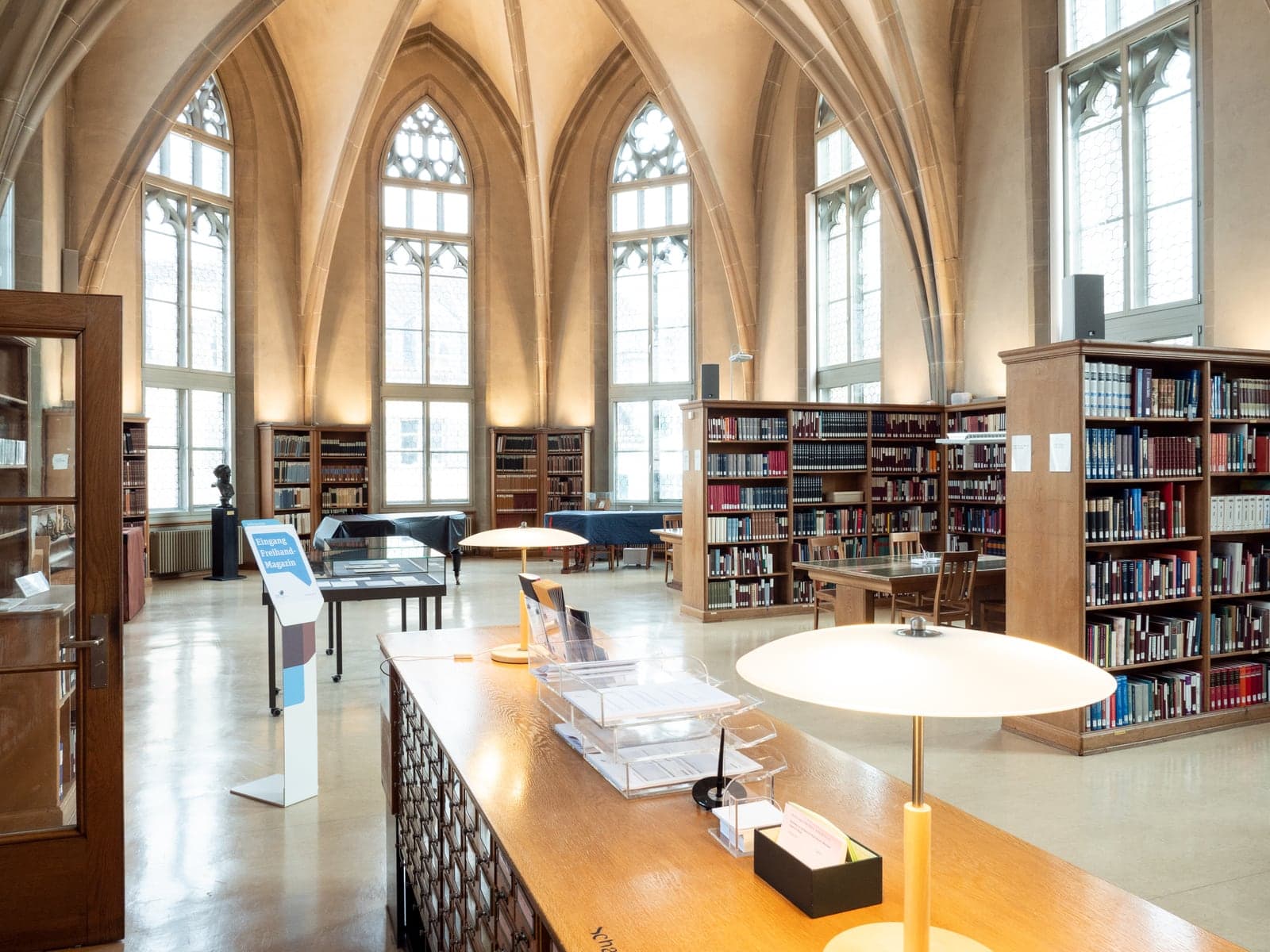
Music reading room · Zentralbibliothek Zürich
Selected public university routes · 2026/27
The key entry requirements
School subjects in the general-education profile
Russian and a second language
Two language subjects within the final three years of school.
Mathematics
Part of the required school subject profile, alongside the language, science and humanities subjects.
Biology, chemistry or physics
At least one natural-science subject in the school record.
History, geography or economics/law
At least one humanities or social-science subject.
A sixth general-education subject
An additional language, science or humanities subject, or computer science or philosophy.
Grades & admission routes
University of Geneva
2 successful university years · 120 ECTS
At a recognised university and programme in a Lisbon Convention country. If the field differs, proof of Russian university admission in the intended field is also required.
University of Bern
2 years of recognised full-time university study
Plus the qualifying Attestat and required university admission certificate.
ETH Zurich
Reduced or comprehensive entrance exam
Attestat + admission to the intended subject at a recognised Russian university: reduced exam. Without that admission proof: comprehensive exam.
EPFL
Attestat + entrance exam
EPFL assesses the school record to determine whether the full or reduced examination applies.
What this means for your childThe school subject profile is only the starting point. A high ЕГЭ score does not replace required university studies or a Swiss entrance exam.
We assess the diploma, subjects and grades against the requirements of the intended programmes.
02
Identify suitable universities
We build a shortlist around your child’s academic profile, interests and preferred teaching language.
03
Plan the next steps
We prepare the application with you. If something is missing, we explain the accepted alternatives and preparation options.
A closer look at the requirements
Explore the detail below, or let us review how it applies to your child.
Compare university requirements · 2026/27
The Attestat is the school-leaving qualification; ЕГЭ (EGE) refers to the unified state examinations. Strong ЕГЭ results alone do not make the Attestat equivalent to a Swiss Maturité for all universities. Families should compare the actual admission routes before deciding whether to begin university studies elsewhere or prepare for an examination.
Selected university examples · undergraduate admission
University
What to check
University of Geneva
Attestat plus two successful university years (120 ECTS) in a university and programme it recognises, in a Lisbon Convention signatory country. If those studies are outside the intended field, an admission certificate for that field from a recognised Russian university is required.
A qualifying Attestat, two years of recognised full-time university study and the required proof of university admission. Confirm the acceptability of the previous programme before relying on it as an entry route.
Attestat plus proof of admission to the intended subject at a recognised Russian university leads to the reduced entrance-exam route. Otherwise the comprehensive examination applies. This is a different route from the two-year condition at cantonal universities.
The published Russian-diploma route is the Attestat plus EPFL’s entrance examination. EPFL decides whether the full or reduced examination applies after assessing the school record. Its preparation-year rules must be checked separately; an 11-year school pathway must not be assumed to qualify for CMS.
Selected public university examples, not a complete admission decision. The full subject combinations, language requirements, application deadlines and programme rules still apply. Medicine has separate restrictions. Universities of applied sciences (HES/FH), private and hospitality schools assess applicants under their own policies. Recheck the conditions for your intended intake.
Considering an applied university, business or hospitality school?
Applied universities (HES/FH), private and hospitality schools have their own entry requirements, which may include practical experience. We assess your child’s record to identify suitable options across these institutions.
Collect the transcripts and ask the chosen university to confirm the route. Then prepare the Bachelor application. Being eligible to apply does not automatically mean entering the third year or receiving credit for all previous study.
02
Your child is still at school
Compare the routes before making the next education decision. Keep language preparation alongside academic planning, and assess the content and workload of any entrance examination before building a timetable around it.
03
The Attestat is the only completed qualification
Build the next step around a route the chosen institution accepts: qualifying university study, an eligible examination, a recognised school qualification, or another suitable institution. ECUS is not the standard answer for every Russian applicant, and a foundation course alone does not establish equivalence.
Attestat and its grade appendix, with earlier school reports where requested.
ЕГЭ results and any official Russian university admission certificate.
University transcripts and evidence of successfully completed study, if applicable.
Required translations, language evidence and the intended degree shortlist.
Questions parents ask
Is there one ЕГЭ score that guarantees Swiss admission?
No single Swiss-wide threshold applies. The institution assesses the qualification and its stated route, which can involve previous university studies or its own examination. A strong ЕГЭ result does not remove those steps.
Do two years at a Russian university automatically allow a transfer?
No. The Swiss university must recognise the studies and confirm the admission conditions. Entry eligibility and recognition of individual course credits are separate decisions; do not assume admission directly into a later year.
Will an equivalence year solve the issue?
Only a specifically accepted outcome can address the gap. Before choosing a provider, identify the qualification or examination to be obtained and have its relevance confirmed. The necessary duration depends on the student and the route.
Sources and scope
Bachelor admission requirements for 2026/27, checked on 4 October 2026.
These references cover the stated academic year. Check the rules for your intended intake when they are published. Meeting an academic threshold does not guarantee a place.
Tell us about their school background and what they want to study. We will help clarify the entry requirements, identify suitable universities and organise the application.